 Avalaunch app
 connects XAVA staking with IDO participation and withdrawal conditions
Updated ·Avalaunch app uses XAVA staking to allocate participation in token sales on Avalanche. These sales, called initial DEX offerings or IDOs, require separate registration and purchase actions. Registration can lock the stake through the sale, while later withdrawals and purchased token claims follow different conditions.
Jump to a section
Staked XAVA creates allocation power
Depositing XAVA into allocation staking gives the position allocation power and access to staking rewards. An allocation represents an opportunity to purchase sale tokens. It does not mean those tokens have already arrived in the wallet. Sale participation remains optional, so a staking position can exist without a purchase commitment.
Several balances serve different purposes. XAVA supports allocation staking, AVAX funds purchases and network transactions, and the purchased project token follows its own distribution schedule. Treating these as interchangeable obscures the cost of participation. An increase in staking rewards also does not establish a gain in the market value of the position.
Account approval and the connected wallet
Sale participation requires an approved identity verification record and the wallet associated with that account. Know your customer verification, usually shortened to KYC, checks identity and eligibility. Wallet verification links a C-Chain address to the account. Avalanche’s C-Chain is the network used for the launchpad’s contract interactions.
A connected wallet alone does not establish sale eligibility. The account must satisfy the applicable restrictions, and the connected address must match the verified wallet. This relationship matters before committing funds: XAVA held under another address does not automatically become the verified account’s stake. Identity verification also involves personal information beyond the public wallet address.
Registration commits the stake to a particular sale
Registering for the Staking Round locks the total allocation stake until the sale finishes. Registration has its own opening and closing times. Account approval and an existing stake do not substitute for joining the selected sale during that window.
The Validator Round has a separate qualification: operating an Avalanche validator node and verifying ownership. The node must remain active during registration and the sale. A larger XAVA balance does not confer validator status.
The registration rules allow a choice between eligible initial rounds, but that confirmed choice cannot subsequently change. The registration record should identify the intended sale and round before the purchase window begins.
A registration attempt with wallet verification unfinished
Consider a hypothetical account with approved KYC, a recorded allocation stake, and unfinished wallet verification. Assume the selected sale’s registration window remains open and its other eligibility requirements are satisfied. The missing wallet link must be resolved before registration can establish participation.
Submitting a registration request immediately leaves that prerequisite unsatisfied. The existing stake does not replace wallet verification. Without an accepted registration record for the selected sale, the account has not secured entry.
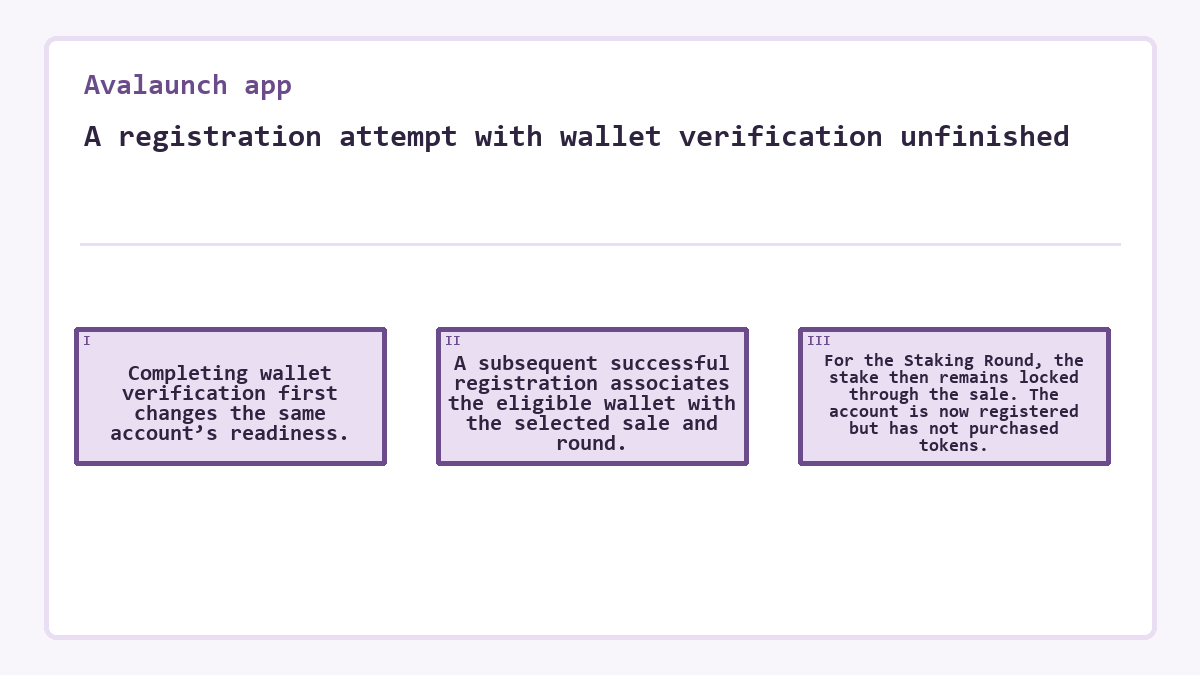
Completing wallet verification first changes the same account’s readiness. A subsequent successful registration associates the eligible wallet with the selected sale and round. For the Staking Round, the stake then remains locked through the sale. The account is now registered but has not purchased tokens.
If the registration window closes before that transaction succeeds, the example’s starting assumption no longer holds. Finishing account verification afterward does not reopen the closed sale.
Manual purchases and funded sale automation
A manual purchase requires participation during the applicable sale window; Auto-Buy executes an enabled purchase using deposited AVAX collateral. Holding AVAX in a wallet and depositing it for automation are different states. The automation needs its funding in the relevant contract.
Auto-Buy must be configured before the sale begins, and the documented rules prevent disabling it once the sale starts. Its funding requirement relates to the predicted allocation and transaction costs. A prediction is not a completed purchase, so the resulting participation record remains the relevant confirmation.
The optional Booster Round purchases additional allocation from unsold tokens after the Staking Round. It requires an advance opt-in, funding, and a completed purchase in an earlier sale round. Available inventory, the round’s allocation limits, and deposited collateral constrain the purchase; enabling the feature does not establish that extra tokens have been bought.
Fees affect different balances
Participation costs include staking deductions, allocation fees, and network transaction fees, with charges in XAVA and AVAX. A staking deposit fee reduces the XAVA credited to the position. An allocation fee relates to the purchased allocation and is collected in XAVA. AVAX transaction costs are separate.
A registration deposit, where required, also differs from the purchase payment. In the documented sale contract, completing a purchase returns the registration deposit; registering without purchasing forfeits it. That return does not reverse the purchase or refund unrelated transaction costs.
Fee percentages are adjustable. The applicable amounts belong in the transaction calculation, rather than an assumption copied from an earlier sale. Staking rewards also vary, so they cannot establish a fixed date when participation costs will be recovered.
Purchased tokens follow their vesting schedule
A completed purchase establishes a token entitlement, while vesting determines when its portions become available to claim. Some sales release tokens together; others divide them into portions with separate unlocking times. A future portion can therefore remain unavailable after the purchase succeeds.
The purchase record, claimable amount, and wallet balance answer different questions. The first shows participation, the second shows what can currently be withdrawn, and the third shows tokens currently held at that address. A claim reduces the remaining entitlement for that portion. A successful purchase alone does not establish that the wallet should hold the full allocation.
The sale’s configured release schedule governs these portions. XAVA unstaking does not substitute for claiming purchased project tokens.
When can XAVA be unstaked after an IDO?
XAVA registered for a sale becomes withdrawable after the applicable sale lock ends, subject to any remaining voluntary term lock, withdrawal authorization, and any post-sale fee.
The cooldown schedule introduced in November 2021 started at a 15% withdrawal fee and declined linearly to zero over 15 days. That announcement explicitly described both values as adjustable. The historical schedule therefore explains the familiar 15-day description, but it is not an immutable protocol constant.
The allocation staking contract calculates the post-sale fee from the time remaining in its configured cooldown window. Its calculation can deduct fees from both the withdrawn stake and pending rewards. The relevant timing belongs to the account’s sale-related unlock record, rather than the date when XAVA was originally acquired.
Waiting through an applicable cooldown removes that particular fee. It does not end a separate voluntary term lock or unlock purchased sale tokens.
Optional term locks exchange flexibility for XAVA Points
Locking XAVA for a selected term adds allocation power through XAVA Points, often abbreviated to XP. These points represent participation power; they are not another freely tradable token balance. The extra points associated with a lock expire when that lock ends.
The term lock creates a firmer withdrawal boundary than a declining cooldown charge. XAVA committed to that term cannot unlock early under the documented locking rules. Paying a post-sale fee does not override the chosen term. The selected duration and multiplier therefore affect both allocation power and the period when the underlying tokens remain unavailable.
Refund rights and vesting sales have separate conditions
A refund depends on the particular IDO’s protection terms, while a vesting sale transfers an eligible portion to another buyer. Neither follows automatically from a falling market price. Refund eligibility can depend on whether tokens remain unclaimed, making the claim decision relevant before a protection period ends.
Avalaunch introduced protection on a sale-specific basis. The April 2023 policy required users to leave tokens unclaimed and avoid Vesting Marketplace interactions for that sale before requesting a refund. Its price conditions and refund window applied to the next sale. Those terms cannot be applied universally to every later IDO. A protected sale needs its own coverage conditions and refund request deadline.
The Vesting Marketplace provides a different exit for supported portions. Listing a portion makes it available to buyers; a completed sale transfers the associated entitlement. A listing alone does not provide proceeds, and marketplace support does not cover every historical IDO.
Completion depends on the asset being withdrawn
Finishing participation means resolving each remaining balance under its own rules. A returned registration deposit, claimed project tokens, and withdrawn XAVA are separate outcomes. None proves that all other balances have settled.
For an unsuccessful withdrawal, the relevant constraints include the recorded unlock time, available stake, and transaction authorization. The allocation staking implementation requires a valid, unexpired authorization signed by a platform administrator for a positive withdrawal amount. Repeating a request cannot remove an active lock or make an expired authorization valid. The account record and transaction status identify which operation remains incomplete.
Remaining in allocation staking preserves participation in its rewards without requiring registration for every sale. Joining another IDO adds a new sale commitment and its applicable restrictions.
Questions people ask about Avalaunch app
Is Avalaunch the same as Avalanche?
Avalaunch is a launchpad that operates on Avalanche, while Avalanche is the underlying blockchain network. XAVA supports the launchpad’s staking and allocation system. AVAX serves a separate role in network transactions and the documented sale payment process. Their similar names do not make the tokens interchangeable.
Do I need KYC to earn allocation staking rewards?
KYC is not required solely to earn allocation staking rewards under the documented staking rules. Joining a token sale requires identity verification and sale eligibility. A reward-earning stake therefore does not, by itself, establish permission to participate in an IDO.
Why might a larger XAVA stake still receive a small allocation?
An allocation depends on the sale’s available tokens, competing allocation power, and any participant cap. Increasing a stake does not establish a fixed purchase amount. The relationship between the position and other participants matters, so allocations from separate IDOs are not directly interchangeable.
Does earned XAVA compound automatically?
Accumulated rewards must enter the staking balance before they contribute as additional staked XAVA. Rewards do not compound continuously by themselves. Avalaunch provides a compounding function for this purpose; the documented contract also compounds pending rewards when it collects a nonzero allocation fee. Using the compounding function applies the deposit fee to the rewards being added, so the increase in stake can be smaller than the gross reward amount.
Which older IDOs lack Vesting Marketplace support?
Sales before the Deepwaters IDO in February 2023 lack Vesting Marketplace support under the published compatibility rule. An older unclaimed entitlement therefore does not automatically qualify for resale. Marketplace compatibility and the original token claim schedule are separate matters.
Has Nullshot replaced Avalaunch?
The November 2025 ecosystem update described Avalaunch as continuing alongside Nullshot under XAVA Labs. It also explained the social account’s transition to Nullshot. That communication change did not establish that Avalaunch had closed or that existing staking and sale positions had migrated.
Are Avalaunch token sales available in every country?
Avalaunch restricts sale participation by jurisdiction and requires an eligible KYC record. Connecting a compatible wallet does not remove those restrictions. Eligibility must cover the particular account and sale; the ability to hold XAVA or earn staking rewards does not establish unrestricted access to token offerings.