 Avalaunch app
 releases your IDO tokens through the project’s claim schedule
Updated ·Avalaunch app lets you claim purchased IDO tokens as the project’s vesting schedule releases each eligible portion. Your purchase records an entitlement; it does not necessarily deliver the entire allocation to your wallet immediately. For a first claim, distinguish the amount purchased, the amount unlocked, and any amount already withdrawn. The participating wallet must connect to the appropriate network, and a completed claim should have a successful transaction record showing the project tokens reaching the intended destination.
Bottom line: A successful IDO purchase records your allocation, while each vesting release determines which tokens you can claim.
Reconnect the participating wallet before the first claim
Suppose your first IDO purchase has completed, but the allocation does not appear when you return to claim. Start by comparing the connected address with the address on your purchase transaction. Avalaunch associates sale participation with the verified wallet; connecting another account does not move that purchase.
The expected starting point is the purchased allocation under that wallet, with its relevant release information. Before submitting anything, reconnect the participating account and select the network required by the sale. These changes let you inspect the position without making another purchase.
Use this short checklist before proceeding:
- If the connected address differs from the purchase record, select the participating account.
- If the wallet cannot connect to the required network, resolve that compatibility problem before signing.
- If the relevant portion remains locked, wait for its scheduled release.
- If claiming would end an applicable refund option, settle that choice before submitting the claim.
- If the portion is claimable, confirm that the wallet can cover the displayed transaction fee.
Once those conditions hold and the allocation shows a claimable portion, submit the claim and inspect its transaction result. Continue only after a successful receipt identifies the expected token transfer. If the transaction remains pending or has failed, do not count the tokens as received. Check the transaction status in the network’s block explorer; approving the transaction in your wallet does not establish completion. A missing connection calls for restoring access, not transferring the allocation elsewhere.
The purchase record and the wallet balance show different stages of the allocation
An IDO purchase can establish a larger allocation than the balance initially available in your wallet. Vesting holds back the unreleased portion, so the difference alone does not indicate a failed purchase. Avalaunch’s sale information separates participation and allocation records from the tokens available to claim.
Keep the purchase quantity as the starting record. Beside it, distinguish tokens already received from tokens that remain subject to release. This makes a partial delivery understandable without assuming that every difference represents a fee. A purchase receipt answers how much you bought; a claim receipt answers what a particular withdrawal delivered.
When does the first portion become claimable?
The first portion becomes claimable when its scheduled unlock arrives and the sale’s applicable claim conditions are satisfied. A sale closing does not establish one universal waiting period for every project.
Avalaunch lets participants claim tokens according to the vesting schedule set by the project. That schedule may distinguish an initial release from later portions. Where the terms mention TGE, the abbreviation means token generation event. Read the release terms for your purchase round: a project’s team, private purchasers, and public-sale participants can have different schedules.
An announced launch date and an available claim are separate facts. If the release date changes, a reminder based on the earlier announcement cannot establish that tokens have unlocked.
Read each percentage against its allocation
A release percentage describes part of an allocation, so its calculation needs the correct base quantity. For a schedule expressed as portions of your purchased allocation, each portion’s quantity follows that allocation multiplied by its assigned percentage.
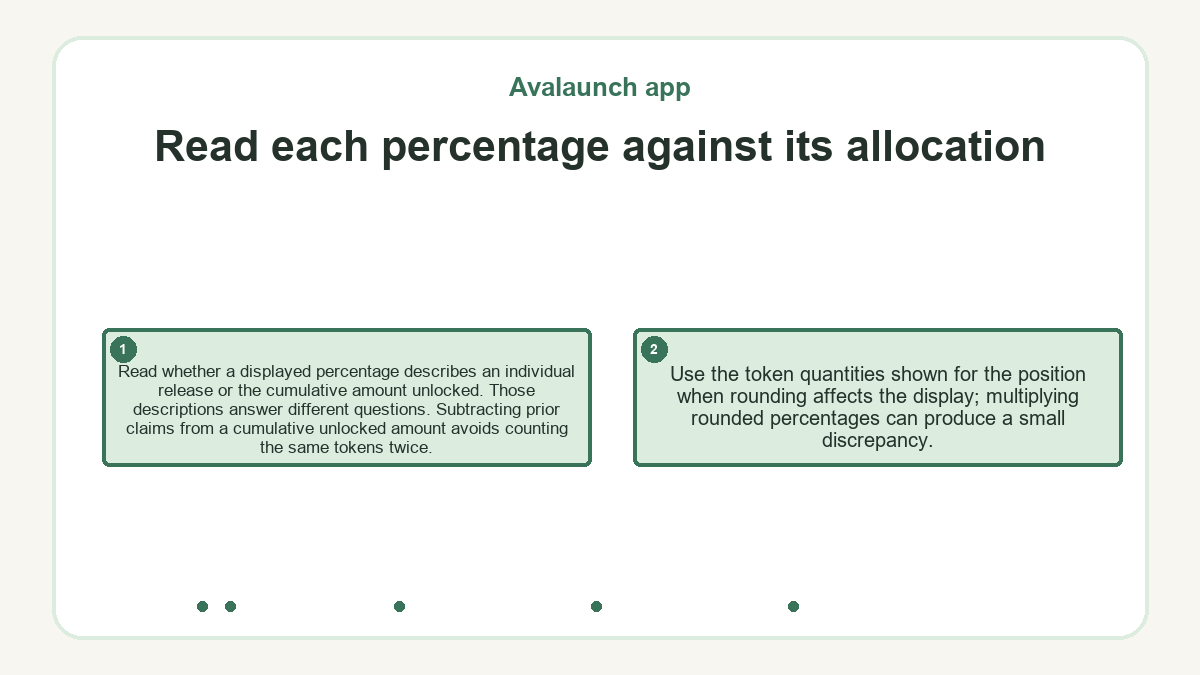
Read whether a displayed percentage describes an individual release or the cumulative amount unlocked. Those descriptions answer different questions. Subtracting prior claims from a cumulative unlocked amount avoids counting the same tokens twice. Use the token quantities shown for the position when rounding affects the display; multiplying rounded percentages can produce a small discrepancy.
Avalaunch’s Sale v2 design assigns unlocking times and percentages to vesting portions. The exact schedule belongs to the sale configuration, rather than a fixed platform-wide installment plan.
Does claiming a portion affect refund eligibility?
Claiming can end refund eligibility when the particular sale’s refund terms exclude participants who have claimed tokens. Resolve that condition before the first withdrawal, even when the amount available is small.
Avalaunch’s April 10, 2023 refund policy excludes users who have already claimed tokens or interacted with the Vesting Marketplace for that sale. Check the refund terms for your specific sale, since its protection conditions and deadlines can differ. This does not create an unconditional refund for every IDO, and an untouched allocation alone does not establish eligibility.
The refund deadline can also differ from the vesting timetable. Waiting for a later installment does not preserve a refund option beyond its own deadline. Where a sale offers a claim-or-refund choice, the first claim has a consequence beyond receiving tokens.
Allow for the transaction fee on each withdrawal
Transactions on Avalanche C-Chain require transaction fees paid in AVAX. A balance of purchased project tokens does not replace the native balance needed for those fees. The wallet’s estimate concerns the transaction being prepared, so a previous claim’s cost is not a fixed quotation for the next one.
Staged releases can require multiple claim transactions over the allocation’s lifetime. The total cost therefore reflects the transactions actually submitted and the network fees when they execute. A smaller portion can face a larger fee relative to its size, even though the network does not charge a percentage of your allocation.
Buying tokens, staking for participation, and withdrawing released tokens are different operations. Keep their charges separate when reconciling what the IDO cost.
A received token may need to be added to the wallet display
A successful transfer can exist on the blockchain before a wallet displays the token correctly. Wallet software may require the token to be added to its asset list, and selecting another network can hide the relevant balance. The transaction receipt and the receiving address’s token holdings help distinguish delivery from a display problem.
The token contract matters when identifying the received asset. A familiar symbol alone cannot establish that a displayed balance belongs to the project you purchased. Adding a token to the display changes what the wallet shows; it does not release another portion or repeat a transfer.
Locked, claimed, and sold portions require different treatment
A portion’s unlock time does not describe its entire status. A previously withdrawn portion has already left the claim balance. A portion offered on the Vesting Marketplace has a different state, and a completed sale transfers its associated claim right to the buyer.
The Sale v2 contract distinguishes available, withdrawn, listed, and sold portions. Consequently, adding up every historically unlocked portion can overstate what the original participant can still withdraw. Reconciliation needs both the release schedule and the disposition of each portion.
For a first purchase with no marketplace activity, this distinction mostly prevents confusion between tokens already collected and tokens still awaiting release.
A displayed position value is not a cash balance
The vesting dashboard can describe an allocation using both token quantities and valuation figures. Its implied value includes the allocation’s claimable and vesting components. A total position can therefore remain larger than the amount available for immediate withdrawal.
Use token quantities to reconcile deliveries. A changing valuation does not establish that another portion unlocked, and a falling valuation does not prove that tokens disappeared. After withdrawal, any conversion into another asset requires a separate transaction under the conditions available at that time. The claim itself delivers the project token rather than the displayed monetary value.
XAVA withdrawals follow a separate timetable
The XAVA stake used for participation and the project tokens purchased in the IDO are separate balances. Avalaunch applies its own staking withdrawal conditions, including a post-IDO cooldown mechanism. Those conditions do not define the purchased project’s vesting schedule.
Keep the two timetables separate. A project-token installment reaching its unlock date says nothing by itself about the cost of withdrawing XAVA. Likewise, a staking withdrawal becoming available does not establish that all purchased project tokens have vested. Recording each asset under its own operation prevents a staking transaction from being mistaken for the final IDO claim.
Reconcile the allocation after the remaining entitlement reaches zero
The last scheduled release and the last completed withdrawal need not occur together. A calendar marks when the final portion should unlock; the claim history records whether you received it. An allocation remains unfinished while you retain eligible, unclaimed tokens.
For a position held throughout vesting, the completed claim quantities should account for the purchased allocation, subject to the sale’s actual token accounting. If you transferred claim rights through the marketplace, include those transfers separately rather than expecting every purchased token to reach your wallet.
Keep the purchase receipt, claim transactions, and any transfer records together. They explain where the allocation went after the dashboard stops showing a remaining claim.
Avalaunch app FAQs
Will a higher transaction fee unlock my IDO tokens earlier?
A higher transaction fee does not change a vesting unlock time. Fees concern transaction processing; the sale’s release conditions determine whether the contract permits a withdrawal. Raising the fee cannot make a locked portion eligible.
Is a token exchange listing the same as the first claim opening?
An exchange listing and an IDO claim opening are separate events. Trading availability does not prove that your purchased allocation has unlocked. Your participation round’s release schedule determines when its tokens become available, even if other holders can already trade.
Does disconnecting my wallet cancel future vesting releases?
Disconnecting the wallet from the interface does not cancel the allocation recorded for its address. Reconnecting restores access to the account view; it does not change the release schedule. You still need control of the appropriate wallet to authorize later claims.